A model can draft a proposal in seconds. Turning that capability into something a business can depend on requires considerably more work.
Someone must understand how proposals are created, connect the model to the right information, check its claims, establish who approves the output and measure whether the process has improved.
Around those responsibilities, a broader AI workforce is taking shape.
For anyone thinking about their next career move, this deserves attention. The opportunity extends beyond the research teams developing new models. It includes people who can build applications, integrate systems, evaluate performance, design better experiences and help organisations adopt new ways of working.
Some of these roles are new. Others are established professions acquiring additional responsibilities. Job titles remain inconsistent, so understanding the work matters more than memorising the labels.
My view is that a strong career strategy begins with a question: which part of making AI useful could you become exceptionally good at?
Consider the following paths:
1. Applied AI engineer
Applied AI engineers turn model capabilities into working software. They might build a customer support assistant, a document analysis product or an internal research tool.
The work involves deciding what information the model needs, how it should interact with other systems and what should happen when its answer is incomplete or incorrect.
A useful foundation includes Python or TypeScript, APIs, databases, Git, testing and deployment. The AI layer adds structured outputs, tool calling, retrieval and evaluation.
Retrieval means finding relevant information and providing it to the model before it answers. This is particularly useful when an application needs to work with company documents or information outside the model’s existing knowledge.
To develop these skills, build a small application around a specific problem. A good starting project is an assistant that answers questions about a collection of public documents and cites its sources.
Then test the uncomfortable cases. What happens when the answer is missing? When two documents disagree? When the user asks something outside its scope?
The portfolio becomes more convincing when you can explain those decisions and demonstrate the results.
2. Forward deployed engineer
The forward deployed engineer works close to customers, translating business problems into deployed software.
Imagine a company asking for “an AI assistant for operations”. Before building anything, someone needs to establish what operations staff actually do, which systems they use, where delays occur and what a successful deployment would change.
This role combines engineering with discovery, delivery and communication. OpenAI’s description includes technical scoping, system design, implementation and production rollout, with success measured through adoption and workflow impact. Its listed requirements also demonstrate that this can be an experienced engineering role. OpenAI’s forward deployed engineer role
The skills include application development, integrations, debugging, requirements gathering and managing trade-offs. You must be able to explain the same problem clearly to an engineer, a department head and an end user.
To practise, find a small business, community organisation or team with a repetitive process. With permission, observe the workflow and build a modest improvement using appropriate data.
Document the original problem, the constraints, what you delivered and how users responded. That case study gives an employer evidence of your ability to work through ambiguity.
3. AI agent and automation engineer
Agent and automation engineers build systems that can take steps towards completing a task.
A support workflow might classify a request, retrieve an account record, draft a response and route it for approval. A more autonomous agent might decide which tools to use as it works through the request.
Those approaches require different levels of control. Anthropic’s engineering guidance distinguishes predefined workflows from agents that dynamically direct their own processes, and recommends starting with the simplest suitable approach. Anthropic’s guide to building effective agents
Useful skills include APIs, authentication, workflow design, state management, retries, logging and approval mechanisms. You also need to understand the consequences of an action: reading a record is different from changing it or sending a message.
Begin with a workflow that performs three or four well-defined steps. Add a human approval before any consequential action. Deliberately introduce a failed API call and a duplicate request, then demonstrate how your system handles them.
The Hugging Face Agents Course provides a practical learning route. Use it alongside your own project so that each concept becomes something you can implement and explain.
4. AI evaluation engineer
A fluent answer can still be wrong. Evaluation specialists develop the methods that help teams distinguish impressive output from dependable performance.
They create test cases, define scoring criteria, investigate failures and compare changes across models, prompts or application versions.
This work exists at different levels. Product evaluation may focus on whether a support assistant resolves requests accurately. Research evaluation can involve designing new methods for measuring frontier capabilities, as illustrated by OpenAI’s Frontier Evals and Environments role. OpenAI’s evaluation research role
Useful skills include Python, data analysis, basic statistics, experimental design and domain knowledge. You need to recognise when a metric is giving a misleading picture.
For a portfolio project, build a test set of 50–100 realistic questions for a document assistant. Include straightforward questions, ambiguous ones and questions the documents cannot answer.
Compare two approaches using the same test set. Report correctness, source support, refusal behaviour, response time and cost. Keep some examples separate from development so you can check whether improvements generalise.
The OpenAI evaluation walkthrough offers an implementation starting point.
5. AI platform and inference engineer
Once an AI application gains users, a different set of questions becomes urgent.
How quickly does it respond? What does each successful task cost? What happens when a provider becomes unavailable? Can the infrastructure support increasing demand?
AI platform and inference engineers work on these problems. Inference is the process of running a trained model to produce an output.
This path builds on backend engineering, cloud infrastructure, networking, observability and distributed systems. Roles involving self-hosted models can also require knowledge of GPUs, memory constraints and model-serving techniques.
A practical starting project is a service that calls a model, records response times and costs, handles failures and exposes a simple monitoring dashboard.
If you already have infrastructure experience, extend the project by comparing a hosted API with a small model you can run within your available resources. Explain the trade-offs using measured results.
For engineers with a DevOps or backend background, this offers a way to apply existing strengths to AI systems.
6. AI product manager and experience designer
AI changes product decisions because its behaviour can vary.
A product team must decide how users check an answer, correct a mistake, understand the evidence and retain control over consequential actions.
An AI product manager needs discovery, prioritisation, analytics and commercial judgement, alongside an understanding of model limitations and evaluation. An AI experience designer needs interaction design and research skills, with particular attention to uncertainty, review and recovery.
These remain distinct professions, although they collaborate closely.
To gain experience, choose a workflow you understand and design an AI-assisted version. Interview potential users, define the problem, create a prototype and test what people actually do with it.
Measure something meaningful: task completion, correction effort or time saved. A polished interface becomes much more persuasive when accompanied by evidence that it helps people finish their work.
7. AI security and governance specialist
AI introduces additional questions about information access, system behaviour and accountability.
A document may contain instructions intended to manipulate an assistant. A tool may grant more access than a task requires. An application may expose information to someone who should not receive it.
Security specialists investigate and mitigate these technical risks. Governance specialists help establish ownership, review processes, acceptable uses and evidence for decisions. In smaller organisations, responsibilities may overlap.
The foundations differ. Security work benefits from application security, identity management and threat modelling. Governance work draws on risk analysis, policy, documentation and organisational processes. Both require a practical understanding of how the AI system operates.
The OWASP guidance for LLM applications provides a useful starting point for understanding application risks.
For a portfolio, assess a demonstration assistant. Map its data access and tools, identify plausible failures, propose controls and test whether they work. Keep the exercise within systems you own or have permission to assess.
8. AI adoption and enablement specialist
A technically capable system still needs people to use it effectively.
AI adoption specialists help teams identify useful applications, redesign workflows, develop practical guidance and build confidence through training. Related opportunities can appear under implementation, customer success, solutions consulting and change management titles.
The skills include facilitation, process mapping, communication, measurement and sufficient technical understanding to recognise limitations.
This can be a relevant path for professionals from operations, customer support, education or business analysis. Their understanding of how work gets done can provide a valuable foundation.
To practise, create a workshop around one specific task. Establish how participants complete it today, teach an AI-assisted method and assess the quality of the result.
A useful case study records what improved, where participants struggled and what required further support.
Across these paths, your existing experience should influence where you begin.
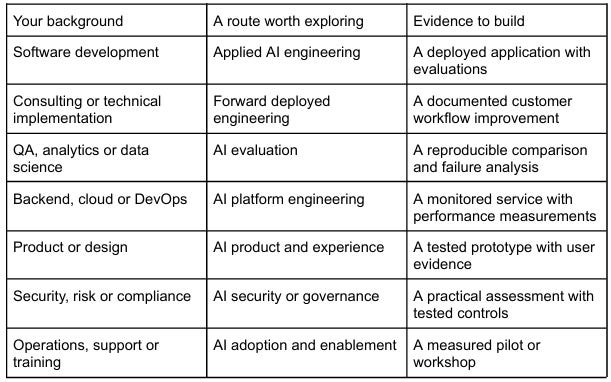
These are possible transitions, rather than guarantees of immediate eligibility. Seniority, sector knowledge and the depth of technical experience still matter.
For readers who want to train or adapt models themselves, machine learning and research engineering provide a further path. That typically calls for deeper study of probability, linear algebra, optimisation, data preparation and frameworks such as PyTorch. Google’s Machine Learning Crash Course and the Hugging Face LLM Course offer foundations for that work.
A manageable learning plan should produce evidence at every stage.
During the first month, select a role and study several relevant job descriptions. Identify the recurring requirements, assess your gaps and learn enough to begin one focused project. If programming is new to you, give the foundations more time.
During the second month, build the project and keep a record of your decisions. Use AI tools to help you learn, but make sure you can explain and debug the work yourself.
During the third month, test it with realistic inputs and, where possible, real users. Write a case study covering the problem, your approach, the results and the remaining limitations. Apply to roles whose requirements align with what you can demonstrate.
Ninety days can establish momentum and produce a credible first project. The time needed to become competitive will depend on your starting point and the role you choose.
When presenting your work, replace broad claims such as “passionate about AI” with specifics. Explain what you built, how you tested it and what you learned. Clearly distinguish a prototype from a production deployment, and report only results you actually measured.
At Amakora, the question that guides our thinking is how powerful models become dependable organisational work. That question creates space for many kinds of talent: people who understand software, customers, infrastructure, risk, design and learning.
You may already possess part of the expertise this work requires.
Choose a problem you understand, acquire the missing skills and build something whose value you can explain. That is a practical place to begin.
Learn with Tochii explores AI, technology and the skills to build with them.
Reflection for the week
A model can draft a proposal in seconds. Making that capability dependable is the work of people: engineers who connect it to the right information, evaluators who check its claims, designers who help users correct it, and specialists who help teams adopt it well.
My interpretation is that the AI workforce is widening rather than narrowing. Many of these roles reward expertise people already have in software, customers, infrastructure, risk, design or learning, combined with enough technical understanding to work with AI systems responsibly.
At Amakora, the question that guides our thinking is how powerful models become dependable organisational work. That question creates space for many kinds of talent. You may already possess part of the expertise it requires.
Choose a problem you understand, acquire the missing skills and build something whose value you can explain. That is a practical place to begin.
Questions to sit with
Which part of making AI useful could you become exceptionally good at?
What evidence could you build in the next 90 days to show you can do that work?
Which skill gap is most worth closing first, and what small project would help you close it?
Which of these eight paths fits you best? Tell me in the comments, and share this guide with someone planning their next career move.
Want to build the skills for these roles?
If you want to work closest to customers, turning business problems into deployed AI systems, Amakora’s Forward Deployed Engineering programme takes an AI product from customer problem to deployed system. It runs for 12 weeks, as a cohort or one-to-one.
Learn more about Forward Deployed Engineering: https://amakoragroup.com/training
If you want to define and deliver AI features, Agentic Product Management covers requirements, tests and success metrics alongside the journey to a shipped product.
For leaders responsible for building AI-ready teams, AI and Agent Leadership focuses on strategy, governance and implementation.
Explore Amakora’s learning programmes: https://amakoragroup.com/ai-courses
Apply for a programme: https://amakoragroup.com/apply
Tochii Achebe, founder of Amakora. Questions or training for your team: contact@amakoragroup.com