
This post is for anyone who builds, buys or signs off on an AI feature. It is written in plain language. You can stop after the first section and still know what to do on Monday.
A customer writes in: “I was charged twice for the same transfer. When do I get my money back?”
The support assistant replies in seconds. The tone is warm. It links the right help article. It is short, polite and well formatted. In a demo, everyone in the room nods.
One sentence in the middle reads: “You will see the refund within 24 hours.”
The company’s actual policy is 3 to 5 business days.
Nobody in the room catches it, because nobody in the room has the policy open. The customer catches it on day two, and then your support team does, and then your compliance team does.
That gap between “looks right” and “is right” is what an eval exists to close. This post walks through how, using one fictional assistant called Kora, built for a fictional Lagos payments app. Kora is not real. The lessons apply to anything you are shipping with a language model inside it.
The one-minute version
An eval is a product specification that runs.
You write down, as examples, what “right” looks like for your product. Then you let a machine check every output against those examples, every time anything changes. The result is a number you can defend in a meeting.
It matters more for AI than for ordinary software for one reason. A normal function gives the same answer to the same input, so one test settles it. A language model is probabilistic. It can be right nine times and confidently wrong the tenth. A demo shows you the nine. An eval counts all ten.
Every eval is the same four-part loop, at any scale:
Cases: realistic inputs, each with a written note of what “right” means.
System: your prompt, model, retrieval and tools, run on every case.
Checks: code, a second model, or a person, each looking for one specific kind of failure.
Score: the share of cases that pass, with a margin of error, compared with the last version.
The rest of this post is organised around five decisions a team faces when shipping AI, and how the loop answers each one.
The trade-off: evals cost a few days up front, mostly spent reading outputs. Your move: spend those days before the architecture is locked in, not after launch. The cost of skipping it: your failure rate gets measured by your customers instead of by you.
Decision 1: what does “right” mean?
The decision: before measuring anything, the team has to agree on what a good output is. Most teams skip this and argue about it later, in production.
Pick cases that look like real life. Kora’s test set is 80 tickets, built from every combination of customer type, topic and situation. That guarantees the awkward ones appear: the furious customer, the vague one-liner, the ticket that raises two problems at once. If you have logs, start from 20 to 50 real failures rather than invented happy paths.
Write the answer key. For each ticket, record the correct category, the help articles the reply must use, and the two or three facts it must state. For the double-charge ticket, the key says: duplicate-charge article; reversal takes 3 to 5 business days.
This answer key is the most valuable thing you will build. It is also a product artefact, not an engineering one. The people who know the policies should write it.
Keep two piles. Use 20 tickets for tuning prompts and checks, and keep 60 untouched for reporting. If you tune on the tickets you report on, your score will flatter you.
In one line: the answer key is your spec. Product owns it; engineering runs it.
Decision 2: where is it breaking?
The decision: which part of the system gets the next sprint. Teams usually answer this by instinct. You can answer it with a count instead.
Start by doing something unglamorous: read the outputs yourself, one at a time. Jot a free form note on each bad one. Then sort the notes into a handful of failure types and count them. Researchers call this error analysis. It is the step most teams skip, and the one that pays back fastest.
Here is what reading Kora’s 60 reporting tickets turned up:
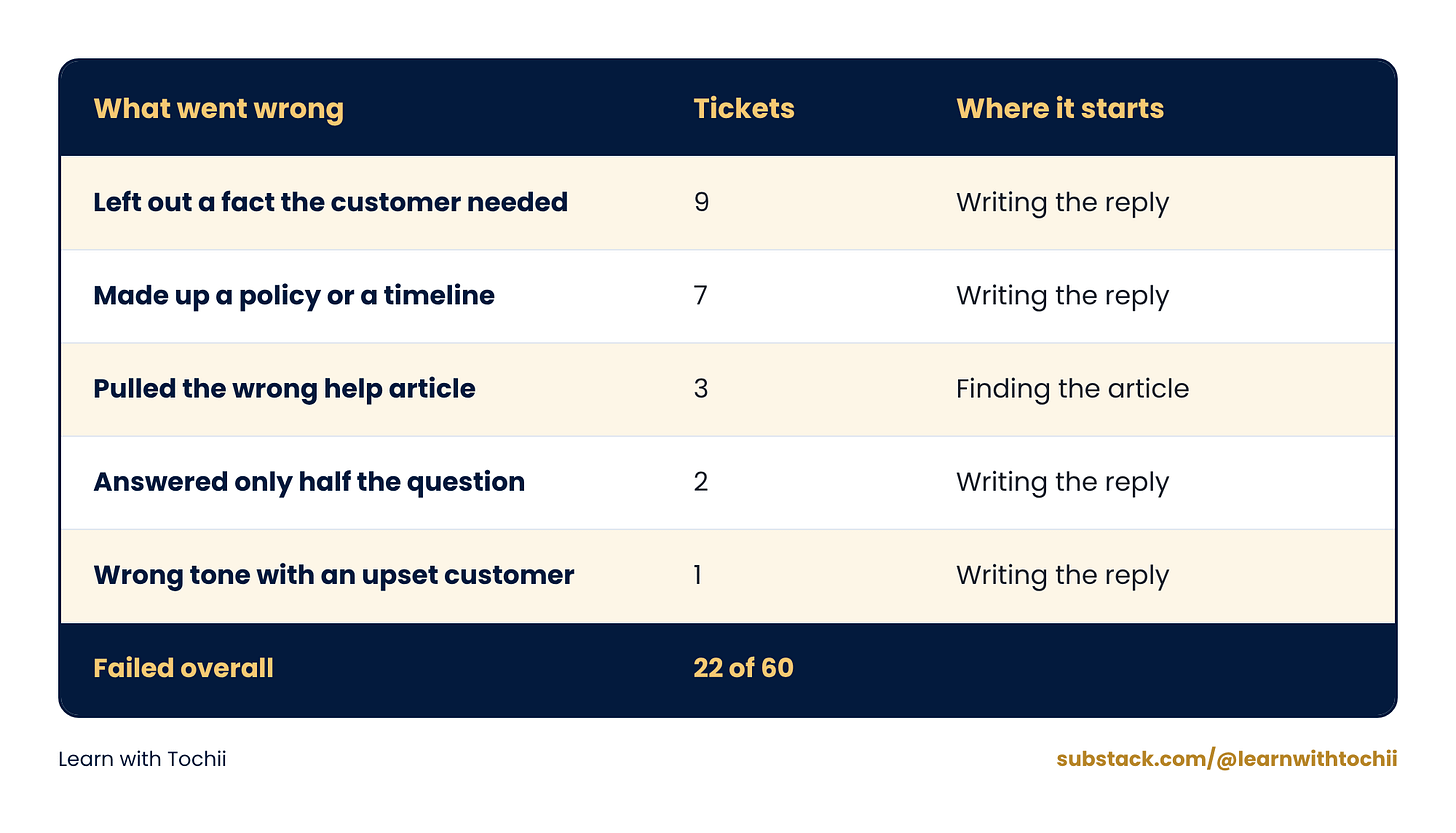
Two things jump out.
First, more than a third of replies fail. The demo gave no hint of that.
Second, look at the last column. The instinct on most teams would be to improve search, because “it found the wrong article” is the failure everyone remembers. But only 3 of the 22 failures start there. Nineteen starts in how the reply is written. A sprint spent on the search index would fix about one problem in seven. The count just saved you that sprint.
The table also becomes your backlog: build a check for each failure type, biggest first.
One warning. As you grade, your own definition of “right” will sharpen, and you will want to regrade earlier tickets. That is normal; researchers have a name for it, criteria drift. Budget two or three passes.
In one line: count your failures by type and by component before you decide what to fix.
Decision 3: who does the grading?
The decision: which checker you trust for which failure. There are three options, and none of them is good at everything.
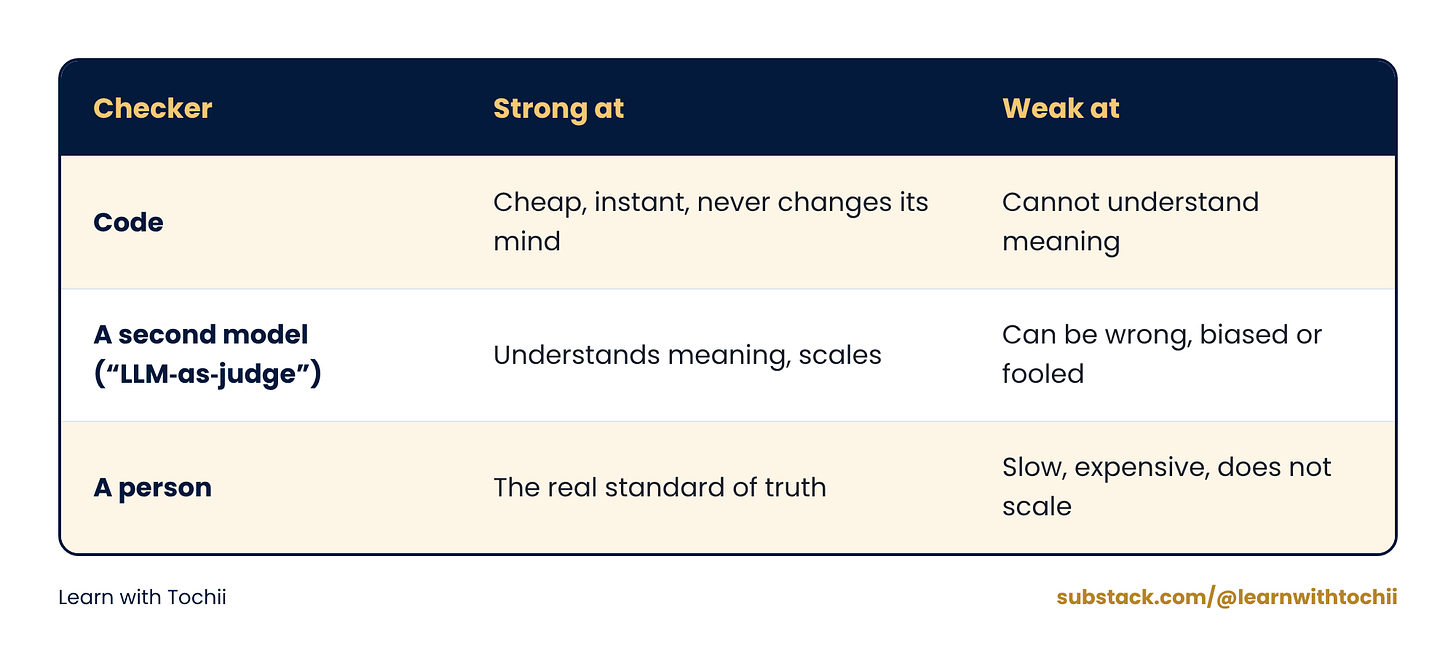
The working answer is to use all three, each where it is strongest.
Code first
Write simple rules for everything with a definite answer. On Kora:
reply under 120 words 41% pass
required facts present 85% pass catches all 9 missing-fact failures
no forbidden promise phrases 97% pass catches only 2 of 7 made-up timelines
The first line is a finding on its own: Kora rambles, and no AI was needed to discover it. The second line kills the biggest failure type for free. The third line shows where code runs out. A rule can look for “within 24 hours”, but the model also wrote “by tomorrow” and “almost instantly”. Five of the seven made-up timelines slipped past.
A model for meaning
For failures that need understanding, use a second model as a judge, with three habits:
Ask one narrow yes/no question per failure. “Does this reply state a timeline the policy does not support?” beats “Rate this reply out of 5.”
Make it quote its evidence, so a person can verify it in seconds.
Show it the source material. A judge that cannot see the policy cannot spot a breach of it.
Then check the judge
A judge is itself an AI system, so it needs its own eval. We hand-labelled the 60 tickets and compared them with a first-draft judge:
people say pass      38     judge says pass   47
agree on             45 of 60 (75%)
bad replies caught   10 of 22
kappa                0.41   → not trusted to block a release yet
Seventy-five percent agreement sounds fine until you try the laziest possible judge: one that passes everything. It agrees with people 63% of the time, simply because most replies are fine. Measured against that baseline, our judge adds very little.
That is why practitioners report Cohen’s kappa, which scores agreement above chance: 0 means no better than guessing, 1 means perfect. A widely used rule of thumb is about 0.6 before a judge can block a release, and about 0.8 before it runs with nobody watching. Our draft is at 0.41. It is too lenient, and it misses more than half of the bad replies.
You improve it on the 20 tuning tickets: tighten the question, show it examples of the failure, hand it the answer key. Some questions get over the bar this way. Those that do not go to a person.
Judges also have well-documented habits to correct for. They tend to prefer whichever answer they see first, longer answers, and answers written by their own model family. The cheap fixes are to swap the order and require agreement, ask yes/no questions that do not reward length, and use a judge from a different provider than the system you are testing.
In one line: code where you can, a judge where you must, and people to keep the judge honest.
Decision 4: should we ship this change?
The decision: someone has a new prompt, a new model or a new retrieval setting, and says it is better. Is it?
Every score has a margin of error. Kora passes 38 of 60 tickets, which is 63%. Rerun the maths on a different 60 tickets and you would get a different number. Resampling the results thousands of times (a technique called the bootstrap) gives the range:
pass rate 63% likely range 52% to 75%
So the truthful sentence is “between about half and three-quarters, most likely 63%”. It feels less impressive than “63%”, and it is what the data supports. Many published model comparisons report differences smaller than ranges like this one.
Compare on the same tickets. A teammate writes version 2 of the reply prompt. We run both versions on the same 60 tickets:
version 1 63% pass
version 2 67% pass
difference +3 points likely range −10 to +17
fixed 9 tickets
broke 7 tickets
call no proven gain → keep version 1
The headline says +3. The range says it could just as easily be worse. The two lines that follow are the ones to show your manager: version 2 fixed nine customers and broke seven others. An average that rises a little can hide a product that got worse for one customer in nine.
Know what your test can see. With only 60 tickets, a change needs to move the score by roughly 15 points before you can tell it from noise. To spot a 5-point slip reliably you need several hundred tickets. If the question you are asking is smaller than what your test can detect, the answer is more tickets, not more cleverness.
In one line: a gain whose range includes zero is not a gain, and always count who got worse.
Decision 5: is it still working?
The decision: whether the thing you shipped last month is still the thing you tested. Models get updated, documents change and customers find new ways to ask.
Run the loop on three clocks:
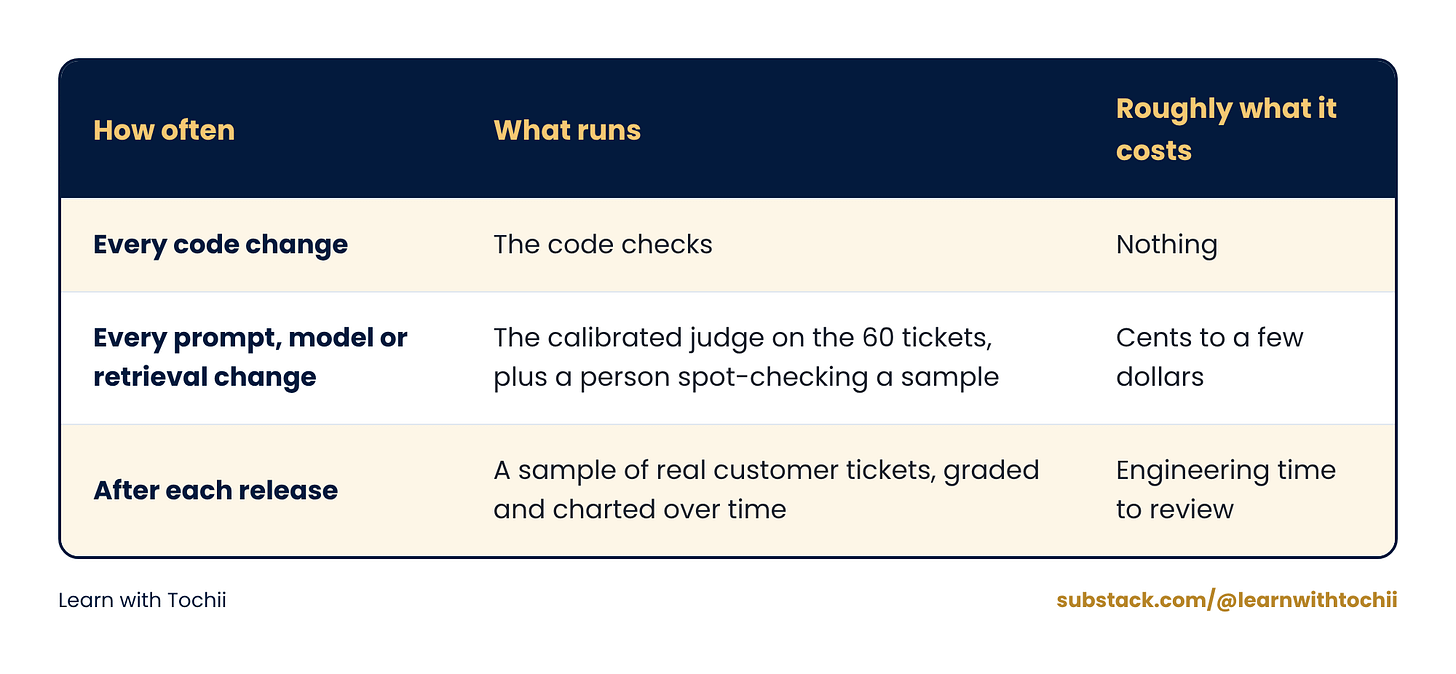
Be honest about your release gate. Kora’s pipeline blocks a merge if the pass rate drops more than 3 points. That is a useful alarm for big breakages. It cannot see small ones, because with 60 tickets a 5-point slip is invisible. Write that limit next to the gate, so nobody mistakes it for a guarantee.
Recheck the judge when its world changes. If you swap the model, the judge or the product area, compare the judge against people again before trusting its numbers.
About cost. Grading 60 tickets with a model judge is a few hundred calls, which is pocket change on most current models. Saving each result and keying it on the prompt and data version makes reruns free. The real cost of evals is attention, not compute.
In one line: test on every change, watch live traffic, and recalibrate when anything underneath moves.
If you sign off on AI: the one-page eval report
You do not need to read transcripts. You need to ask for one page with five lines, and to send it back if any line is blank.
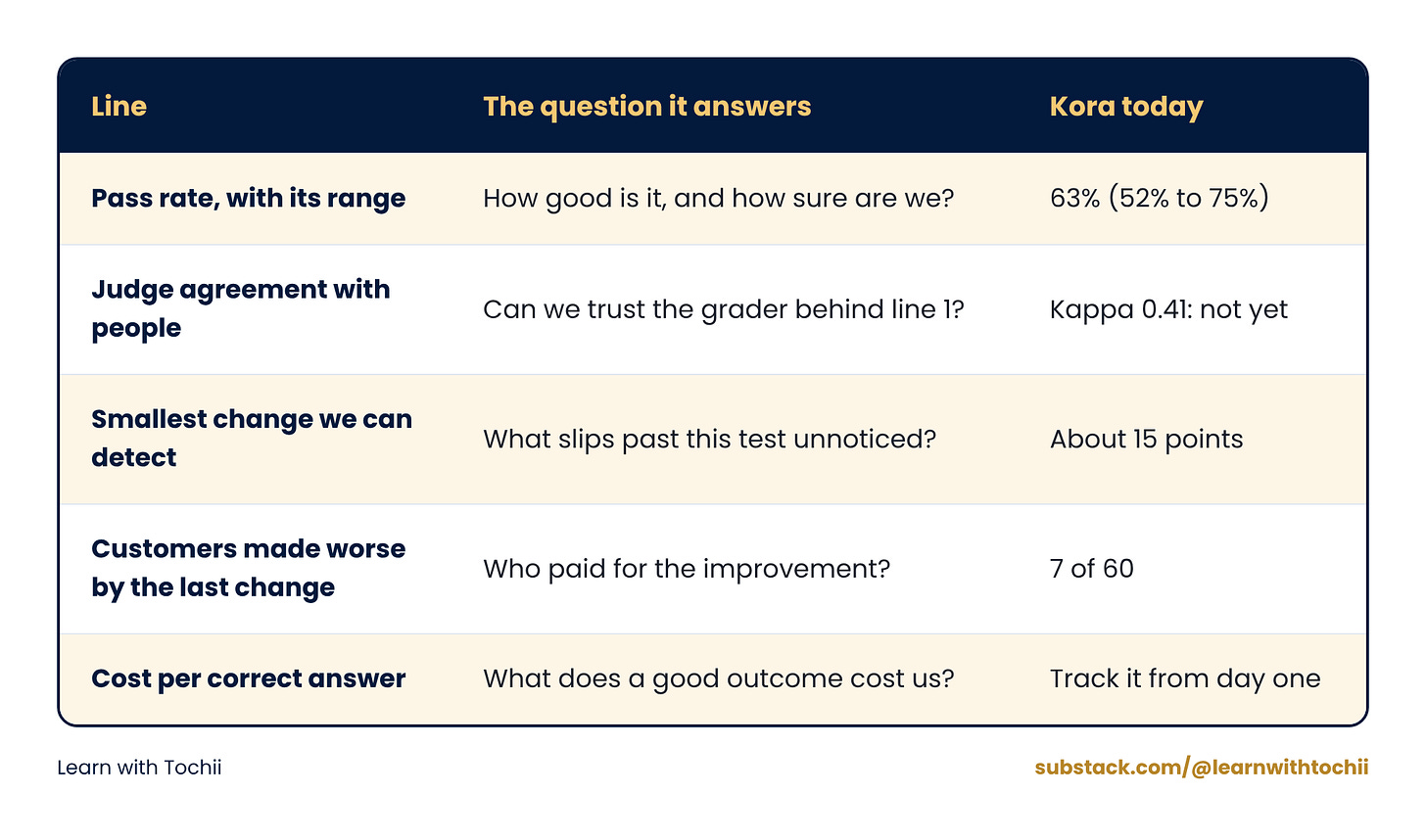
Read together, Kora’s page says: promising, not ready, and the test is not yet sharp enough to tell. That sentence is worth more than any demo.
Cheat sheet
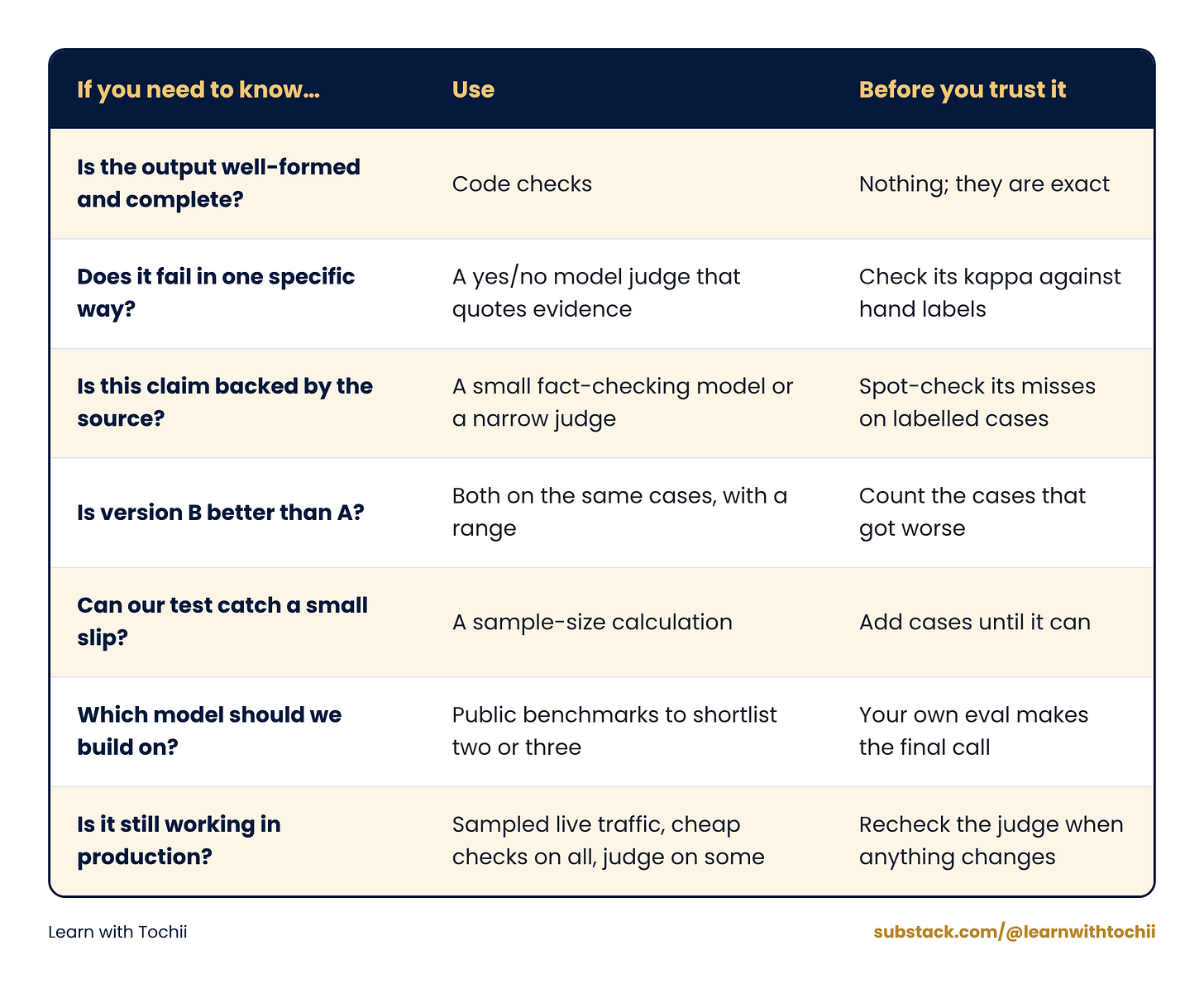
Seven rules to keep
The answer key is the product spec. Have the people who own the policy write it.
Read before you automate. Your first week is reading outputs, not choosing tools.
Fix what the count says, not what you remember. Kora’s search was fine; its writing was not.
Code first, a judge second, people as the referee.
Beat the lazy baseline. A judge that passes everything is your floor, not zero.
No range, no claim. And always count who got worse.
Write down what your test cannot see. A gate with unstated limits gives false comfort.
The real point
Evals are not a QA task bolted on at the end. They are how a team decides, with evidence, what “good” means, where to spend the next sprint, and whether a change is safe to ship. You can make those decisions before a line of production code is written, which is the cheapest time to make them.
The 24-hour refund is still in Kora’s replies today. The difference is that now the team knows how often it appears, which part of the system writes it, and whether the next version makes it better or worse.
Reflection for the week
Every AI demo tells the story of the nine good answers. The work that matters is finding the tenth before a customer does.
This week, pick one AI feature you build, buy or sign off on, and ask a simple question: how would we know if it were wrong? If the honest answer is “someone would complain”, you do not have an eval yet. You have a hope. The good news is that the first step costs nothing but attention: sit down and read what your system actually says.
Questions to sit with
If you had to write the answer key for your AI product today, who on your team actually knows what “right” looks like?
The last time your team said a change made things “better”, did anyone count who it made worse?
What is one failure your current tests cannot see, and what would it cost if a customer found it first?
Over to you: if you are building something with a model inside it, what would you put in your answer key? Tell me in the comments. I read every one. If this was useful, subscribe; the next issue goes one level deeper on agents, where “right” means the right action, not just the right words.
Want to build AI products that hold up in the real world?
Learn with Tochii is backed by Amakora. If this article made you want to go deeper, these programmes are a good next step:
Agentic Product Management: for product people defining, testing and shipping AI products. Explore AI courses
AI and Agent Leadership: for the leaders who sign off on AI and need to ask the right questions. Explore AI courses
Training for your team: amakoragroup.com/training
Apply now or talk to us.
Tochii Achebe, founder of Amakora. Questions or training for your team: contact@amakoragroup.com
Kora and every number in this post are illustrative, from a small simulated example built for teaching. The format was inspired by a long-form explainer on evals by @sermakarevich on X; the example, structure and analysis here are my own.
Further reading
Husain, H. (2024). Your AI product needs evals.
Husain, H. & Shankar, S. (2025). AI evals for engineers and PMs, course materials.
Shankar, S. et al. (2024). Who validates the validators?
Zheng, L. et al. (2023). Judging LLM-as-a-judge with MT-Bench and Chatbot Arena.
Dubois, Y. et al. (2024). Length-controlled AlpacaEval.
Panickssery, A., Bowman, S. & Feng, S. (2024). LLM evaluators recognize and favor their own generations.
Miller, E. (2024). Adding error bars to evals. Anthropic.