
There is a familiar feeling that comes with another AI announcement. You see the demonstrations, read the headlines and begin to wonder whether you are already behind.
Then you return to your day. There is a proposal to finish, a customer waiting for a response, an idea you have been meaning to develop and perhaps a job application that deserves more attention than you have been able to give it.
For me, this is where the conversation about AI becomes meaningful. What can this technology actually help you accomplish?
As a founder, I think about capacity quite a lot. We all have ambitions, but we also have responsibilities. The opportunity to make better use of our time deserves serious attention.
GPT 6 Astra is worth understanding through that lens.
OpenAI describes Astra as its most capable model for complex work, including reasoning, research, coding, computer use and document creation. Its API supports tools such as web search, file search and code execution. In practical terms, an appropriately equipped application can use it to work with information and carry out steps towards a finished result. OpenAI model documentation
The distinction between the model and the application matters. Astra does not automatically have access to your email, business records or social accounts. What it can do depends on the product you are using, the tools connected to it and the permissions you provide.
My view is that the potential benefit comes in three forms: less time spent assembling information, more opportunity to examine your thinking and a shorter journey from an idea to something you can review.
Astra sits within a much bigger year for AI
If the names are beginning to blur together, that is understandable. This year has brought several model releases, each with its own positioning.
It helps to understand what those differences mean before deciding that every task needs the newest model. Some of them include:
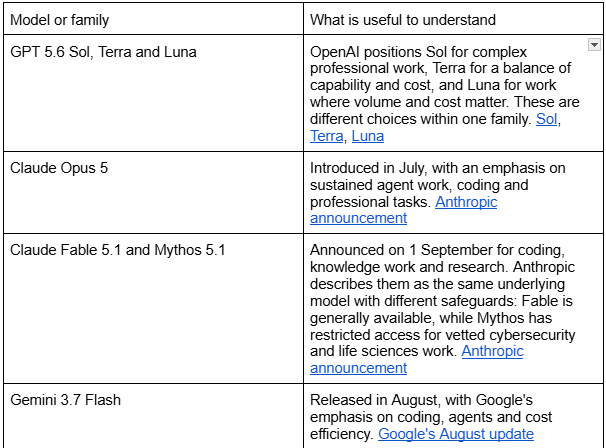

These descriptions reflect the providers’ positioning. They do not establish which model will perform best on your particular work.
For a small business, I would begin with the task and the cost of getting it wrong. Sorting routine enquiries and developing a complex expansion proposal deserve different levels of attention. For a creator, I would distinguish writing the script from generating the accompanying media.
Give two suitable options the same brief and source material. Compare accuracy, usefulness, editing time and total cost. The answer becomes much more meaningful when it comes from your own work.
What is an AI harness, and why should you care?
You may also hear people talking about a “harness”. The name sounds technical, but the idea is quite practical.
A harness is the software around a model that manages how it works: supplying context, making tools available, running actions and returning their results so the model can decide what to do next. For longer tasks, it also needs ways to preserve progress and check completion. Anthropic’s work on agent harnesses shows why progress records, a prepared environment and actual testing matter when work spans multiple sessions. Anthropic’s harness research
Think about asking AI to prepare a client proposal.
The model helps interpret the brief and develop the argument. The surrounding system needs to retrieve the right discovery notes, open the proposal template, save the document and give you a way to review it. If a tool fails, the system needs a sensible way to recover.
That is why the same model can feel very different in two applications.
The Claude Agent SDK is one example of a harness developers can build around. A developer toolkit, however, still requires someone to configure the workflow. It is a different proposition from opening an application and beginning your work.
OpenAI’s Astra guidance makes a related distinction: even when the model can request tools asynchronously, the application still executes those tools and manages the pending work. Model capability and application design have to work together. OpenAI’s Astra guidance
For your own purposes, ask what the system can access, what it can change, how it retains progress and how you inspect the result. A useful business setup should also make permissions and spending limits clear.
Imagine a weekly customer report. You might want AI to read approved records, identify recurring issues and save a summary. You might want to review any proposed customer messages before they are sent. Those are workflow decisions that need to be built into the surrounding system.
This is also why I care about the execution layer we are building at Amakora. Intelligence becomes commercially useful when it can work within the realities of an organisation: its systems, responsibilities and standards.
With that distinction in mind, the following examples become easier to apply. Choose a suitable model, give it a useful environment and be clear about the result you need.
The following are ten workflows I would encourage you to try. They are practical suggestions, rather than promises of a particular result.
1. Content creators: develop one idea into a coherent body of work
A good idea deserves room to develop. Yet producing the video, newsletter, captions and supporting research can become a considerable undertaking.
Start with your own material: a transcript, rough notes and two or three examples of content that sounds like you. Then ask Astra to develop the idea for different audiences and formats.
A prompt to try:
Using this transcript and my writing samples, develop a newsletter, a five-minute YouTube script and three short video scripts. Preserve my argument and personal examples. Give each piece a distinct purpose, and flag claims that need verification.
For Learn with Tochii, I would use this approach to take a technical concept and explain its relevance to a founder, a working professional and someone encountering AI for the first time.
The benefit is a more considered publishing process. Judge it by the editing time you save and the quality of the audience response.
2. Executives: prepare for decisions with greater clarity
Leadership requires you to make decisions from information that is often incomplete, scattered or contradictory.
Give Astra the relevant reports, meeting notes and performance data. Ask it to organise the evidence around the decision you need to make.
A prompt to try:
Prepare a two-page decision brief on whether we should expand this service. Compare the options, identify the assumptions behind each and highlight any conflicting evidence. Finish with the questions the leadership team must resolve.
This creates a useful starting point for a substantive discussion. Ask it to challenge the preferred option as well. A polished brief has little value if it merely reinforces what everyone already wants to believe.
3. Small business owners: understand recurring customer problems
A customer complaint can tell you something about your entire operation.
Provide an anonymised set of enquiries, complaints and reviews, together with your current service policies. Ask Astra to identify repeated issues and suggest where the underlying process needs attention.
A prompt to try:
Group these enquiries by problem. Draft responses using our policies, identify gaps in our website information and recommend three operational changes that could reduce repeat enquiries.
A salon might discover confusion around deposits. A retailer might find that delivery expectations are unclear. A consultancy might realise that customers do not understand what happens after payment.
Measure whether repeat questions fall and customers receive clearer answers.
4. Jobseekers: communicate the value of your experience
It can be difficult to describe your own work, particularly when you have spent years doing it without keeping a careful record.
Give Astra your CV, the job description and a factual account of projects you have delivered.
A prompt to try:
Map my experience to this role. Rewrite the relevant CV sections using only supported facts. Identify gaps honestly and help me prepare five interview examples. Ask for missing information rather than inventing achievements.
The benefit is a clearer connection between what you have done and what the employer needs.
You still need to understand and defend every sentence. Your application should give you confidence when the interview begins.
5. Working professionals: make your contribution visible
Many capable people deliver valuable work that remains poorly documented.
Keep a simple weekly record of problems solved, decisions made, feedback received and outcomes achieved. Astra can help turn those notes into a useful account of your contribution.
A prompt to try:
Use these weekly notes to prepare my performance review. Separate completed outcomes from work in progress, connect each contribution to team objectives and identify where evidence is missing.
This also helps you recognise patterns in your own development. Perhaps you consistently resolve difficult customer issues or make complicated projects easier for others to deliver.
That is useful information when discussing progression, responsibilities or your next role.
6. Founders: examine an idea before committing heavily
Enthusiasm is valuable. So is finding out where your assumptions are weak.
Give Astra your proposed customer, problem, offer and existing evidence. Where research tools are available, ask it to investigate relevant alternatives and cite its sources.
A prompt to try:
Challenge this business idea. Identify existing alternatives, distinguish evidence from assumptions and design a small customer validation exercise we can run within two weeks.
The output could include interview questions, a draft landing page and a way to record responses.
Use it to prepare for real customer conversations. Those conversations will tell you things a desk research exercise cannot.
7. Sales teams and consultants: write proposals that reflect the conversation
A proposal should demonstrate that you have understood the client’s situation.
Start with discovery notes, your service information and verified examples of previous work.
A prompt to try:
Draft a proposal linking each deliverable to a problem raised in these notes. Include scope, dependencies, milestones and success measures. Mark missing prices and commitments for me to complete.
This can reduce the time between a productive conversation and a credible proposal.
Read it carefully for anything your organisation has not agreed to deliver. The strongest proposal is one you can execute with confidence.
8. Small business operators: turn a spreadsheet into useful questions
A spreadsheet can contain a great deal of information without making the next action obvious.
With data analysis tools available, provide a clean export of orders, products or service bookings. Explain what each column means and how the business operates.
A prompt to try:
Analyse these orders for repeat purchases, cancellations and product trends. Check for missing or duplicate records first. Show your calculations and suggest three questions we should investigate.
You might discover that one product attracts first-time customers while another brings them back. You might also discover that your records are not yet reliable enough to support a conclusion.
Both are useful findings. Start by checking the analysis against figures you already know.
9. Product teams: make an idea tangible enough to test
People often interpret the same written requirement differently. A prototype gives them something concrete to discuss.
Provide the user problem, an example journey and clear boundaries for the first version.
A prompt to try:
Build a simple prototype of this customer onboarding journey using sample data. Include the main screens, test the core interactions and explain what remains unfinished.
This workflow needs an environment with the appropriate coding and testing tools.
The benefit is earlier feedback. Put the prototype in front of users and observe where they hesitate, what they misunderstand and whether it helps them complete the task.
A working demonstration is a starting point for that learning.
10. Managers: turn repeated explanations into useful training
When knowledge lives entirely in experienced employees’ heads, onboarding becomes harder than it needs to be.
Give Astra your existing procedures, approved examples and common questions.
A prompt to try:
Turn these materials into an onboarding guide for a new colleague. Explain each process, include realistic practice scenarios and flag contradictions for the process owner to resolve.
Have someone who knows the work review it, then ask a new colleague to use it.
Their questions will help you improve the guide. Over time, this can make training more consistent and reduce the number of routine explanations your team has to repeat.
A reflection before you begin
The most useful AI workflow is rarely the most impressive one.
It is usually the task you already understand, repeat often and wish you had more time to do properly.
Perhaps it is preparing for a difficult meeting. Perhaps it is turning scattered notes into a clear proposal. Perhaps it is finally making sense of the customer questions that keep arriving in your inbox.
The point is not to hand over your judgement. It is to create more space for it.
AI can help you gather, organise, compare and develop information. You still need to decide what matters, what is accurate and what should happen next.
That is why I would encourage you to begin with one meaningful task rather than trying to transform everything at once.
Give it a proper brief
Across these examples, the principle is consistent: explain the work well.
Give Astra the outcome you want, the relevant context, the materials it should use, the boundaries it should respect and what a satisfactory result looks like.
“I need a marketing plan” leaves a great deal unresolved.
“I run a local catering business, want more weekday corporate bookings and have these customer reviews and this budget. Develop a four-week campaign for review” gives the task direction.
Start with one recurring piece of work. Record how long it normally takes, try the new workflow and include your review time when judging the result. Keep what improves the work.
I want more people to feel capable of participating in this technology. A creator should be able to develop an idea with care. A small business owner should have room to think beyond the next urgent request. A professional should be able to communicate the value they already bring.
That is the opportunity I see here.
Choose something that matters in your week. Give it context, apply your judgement and see how much further you can take it.
The question worth sitting with this week:
What is one task you return to every week that could benefit from AI, and what would you do with the time and attention you gained?
Help shape future Learn with Tochii articles
I’m putting together future guides on practical ways professionals and business owners can use AI in their work.
Which of these ten use cases would you like me to walk through in more detail?
Your response will help decide what I write about next.
Want to learn how to use AI effectively across your work?
Our AI for Business Professionals programme teaches you how to think with AI, learn with it and build workflows that make your time more productive.
If this article has helped you identify somewhere to begin, the programme can help you develop that interest into a more deliberate way of working. Bring the tasks you want to improve and learn how to give AI useful context, assess its output and apply it with greater confidence.
You can also explore our wider learning opportunities through Learn with Tochii, where we share practical guidance, workshops and courses designed to help you use technology with greater clarity and confidence.
Until next week,
Tochii
Founder, Learn with Tochii
Inspire · Educate · Empower