Here is a question that comes up constantly and rarely gets a clear answer.
Someone hears that Llama is open source. They hear that GPT and Claude are not. They assume this is a technical detail that only matters to engineers.
It is not. It is one of the most consequential decisions in how you build with AI, and most people are making it without realising they are making it at all.
This week, we define the difference simply, walk through the actual models in each camp, and give you a clear framework for when each one is the right choice.
The simplest possible explanation
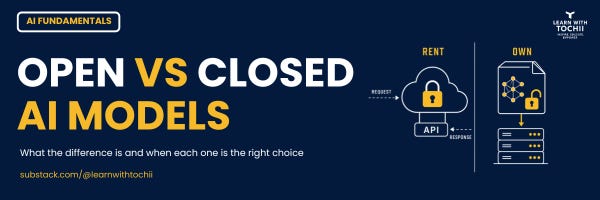
A closed model is one you can only use by sending your request to someone else’s server and getting a response back. You never see how it works underneath. You never hold a copy of it. You are always, for every single request, dependent on that company’s servers being available, their pricing staying reasonable, and their rules continuing to allow what you are trying to do.
An open model, more precisely called an open-weight model, is one where the company has published the actual trained model file. You can download it. You can run it on your own computer or your own company’s servers. Once you have that file, you do not need permission from anyone to keep using it, and nobody can switch it off.
Closed model: you are renting intelligence by the request. Open model: you own a copy of the intelligence outright.
That is genuinely the whole concept. Everything else in this article is detail sitting on top of that one distinction.
The closed model landscape
Every model most people have actually heard of is closed.
GPT (OpenAI). Every GPT model, including the current GPT-5.6 family, is closed. You access it through the ChatGPT app or the API. OpenAI has never released the underlying weights for any GPT-4 class model or later.
Claude (Anthropic). Every Claude model is closed, including Opus, Sonnet, and Haiku. This also includes Claude Fable 5, Anthropic’s most capable publicly available model, which is worth pausing on because its story is a genuinely useful illustration of exactly what closed means in practice.
Gemini (Google). Every Gemini model, Pro, Flash, and Flash-Lite, is closed and accessed only through Google’s own infrastructure.
Closed does not mean secretive or untrustworthy. It means the company retains full control over the model at all times, including the ability to update it, restrict it, or shut off access entirely.
What Claude Fable 5 teaches us about what closed really means
Fable 5 launched on June 9th, 2026, as Anthropic’s most capable public model, built on top of an internal tier called Mythos. Within three days, the US Commerce Department issued an export control directive and forced Anthropic to disable the model for every user in the world, everywhere, including Anthropic’s own foreign national employees. Not because of anything a specific user did. Because a government agency decided the capability was too significant to be freely available.
Anthropic could not comply selectively. There was no way to keep it running for some users while blocking others, because the model exists on Anthropic’s servers, under Anthropic’s control, subject to the laws Anthropic itself must follow. The switch was flipped for everyone at once. Access was restored eighteen days later on July 1st, with additional restrictions in place.
This is not a criticism of Anthropic. It is the clearest possible illustration of what it actually means to depend on a closed model. Your access exists entirely at the discretion of the company running it, and in this case, at the discretion of whatever regulatory environment that company operates within. If you had built a product on Fable 5 in that window, your product went down too, and there was nothing you could have done about it.
The open-weight model landscape
Now the other camp. These are models where a company has trained something capable and then published the actual weights publicly, for anyone to download and run.
Llama (Meta). Meta’s family of open-weight models, released under a licence that permits most commercial use. Llama models range from small versions that run on a single consumer GPU to large versions competitive with closed frontier models on many benchmarks.
DeepSeek. A Chinese lab that has become the standard-bearer for genuinely open, permissively licensed models, released under the MIT licence, one of the most unrestricted licences available. DeepSeek’s models have repeatedly matched or approached closed frontier model performance at a small fraction of the training cost, which has reshaped the entire industry’s assumptions about what open models can achieve.
Qwen (Alibaba). Another strong open-weight family, frequently benchmarked as competitive with mid-tier closed models like Claude Sonnet, at a fraction of the cost when accessed through a hosting provider.
Mistral. A European lab producing both open and closed models, giving users a choice depending on the specific model version.
What owning the weights actually gets you
Four concrete things change the moment you are running an open-weight model rather than calling a closed API.
Nobody can turn it off. The Fable 5 story could not happen to an open-weight model you are running yourself. Once you have the file, it runs until your own hardware fails or you choose to stop it. No government directive, no company policy change, no pricing update reaches a model sitting on your own server.
Your data never has to leave your building. With a closed API, every request you send travels to someone else’s servers. With a self-hosted open model, your data can stay entirely inside your own infrastructure. For regulated industries, government work, or anything involving sensitive client information, this is often the deciding factor rather than a nice-to-have.
The cost structure changes completely. A closed model charges you per token, forever, for every single request. An open model has an upfront cost, the hardware or the hosting, and then running it costs comparatively little per request. At high enough volume, this flips the economics entirely in favour of open models.
You can change it. Open weights can be fine-tuned, meaning further trained on your own specific data to make the model better at your specific task. You cannot do this with a closed model. You are permanently using the general-purpose version the company decided to ship.
What you give up
None of this is free. Open models come with real trade-offs.
You need infrastructure. Running a capable open model yourself requires real hardware, specialised GPUs that are neither cheap nor simple to configure, or a hosting provider who handles that layer for you at a cost.
You are usually a step behind the absolute frontier. The most capable model available at any given moment is almost always closed. Open models catch up over time, sometimes remarkably quickly, but the newest, single most capable model tends to launch closed first.
You own the maintenance. Updates, security patches, and performance tuning become your responsibility rather than something a company handles invisibly on your behalf.
A simple way to decide
Ask yourself three questions before choosing.
How sensitive is what you are sending it? If you are working with confidential client data, regulated information, or anything where data leaving your building is a genuine risk, that pulls strongly toward an open model you can self-host.
How much volume are you running? A handful of requests a day makes a closed API’s pay-per-token pricing genuinely convenient. Thousands of requests a day starts to make the upfront cost of running your own open model look increasingly sensible.
How much does the absolute best available capability matter for this specific task? If you need the single most capable model that exists right now, for something like advanced coding or complex reasoning, that usually still means a closed frontier model. If a strong, good-enough model handles the task well, an open model often gets you there for a fraction of the cost.
The honest, simple summary
Closed models are the easiest way to get access to the most capable AI available at any given moment. You pay per use, you never manage any infrastructure, and you are trusting the company behind it to keep the lights on and the rules reasonable.
Open models trade a little bit of convenience and, usually, a small step behind the absolute frontier, for genuine independence. Nobody can take them away from you. Your data can stay entirely under your own control. And at scale, they are often meaningfully cheaper.
Most serious organisations end up using both. A closed frontier model for the hardest, highest-stakes tasks where the best available capability is worth paying for. An open model, self-hosted or through a low-cost hosting provider, for the high-volume, sensitive, or cost-conscious work sitting underneath it.
Reflection for the week
The Fable 5 story is not really a story about export controls. It is a story about what it means, in very concrete terms, to build something important on top of infrastructure you do not own or control.
That does not mean closed models are the wrong choice. For most people, most of the time, they remain the simplest and most practical option. But understanding the trade-off, genuinely understanding it, changes how you make decisions about what to build on top of, and what happens to that decision the day something outside your control changes upstream.
The question worth sitting with this week:
Somewhere in what you are building or relying on right now, are you depending entirely on a closed model with no fallback? And what would actually happen to you if that access disappeared tomorrow?
Help shape future Learn with Tochii articles
I’m putting together future guides on practical ways professionals can use AI at work, in school, and in everyday life.
What’s one AI question you’ve always wanted answered?
Your responses will help decide what I write about next.
Take the 2-minute survey: https://bit.ly/LWTsurvey
Want to understand AI infrastructure well enough to make this call confidently?
Model selection, open versus closed trade-offs, and building resilient AI systems are core parts of what we teach in Amakora Group’s AI programmes.
Explore our courses: amakoragroup.com/programs
Apply for the fellowship: amakoragroup.com/apply
Until next week,
Tochii
Founder, Learn with Tochii | Amakora Group
Inspire · Educate · Empower
📧 contact@tochukwuachebe.com
🌐 https://www.tochukwuachebe.com