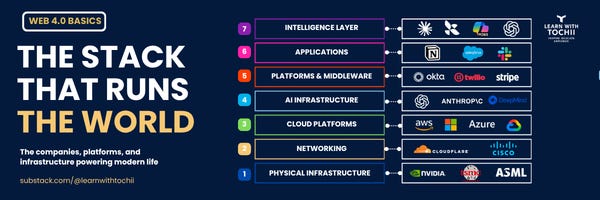
The World Runs on Layers You Cannot See
When you open your banking app and check your balance, a sequence of events happens in milliseconds that involves hardware sitting in a data centre in another country, software written by engineers you will never meet, protocols designed decades ago, a cloud platform running on servers owned by one of three American companies, and an AI model that decided whether to flag your last transaction as unusual.
None of that is visible to you. You see a number on a screen.
That invisibility is the point. The best infrastructure is the kind you never think about. The systems that power your daily life, from the moment your phone receives a notification at 7am to the moment a payment clears at 11pm, are so deeply layered and so deeply interconnected that most people have no mental model for them at all.
But here is why that matters now more than it ever has.
AI has changed the stakes of understanding the stack. The companies and countries that understand how these layers work, who controls them, and how they interconnect are the ones making the decisions that will define the next twenty years. The professionals and leaders who understand the stack are the ones who can ask the right questions, make better product decisions, and see opportunities that are invisible to everyone else.
This article is a plain-language breakdown of every major layer. Not a technical manual. A strategic education. By the end, you will have a clear mental model of the infrastructure that runs your world, the companies that control it, and why it is built the way it is.
Understanding the stack is not just a technical skill. It is a strategic one. The layer you do not understand is the layer someone else controls on your behalf.
The Seven Layers — A Map
Every digital system you interact with is built from seven fundamental layers, each one sitting on top of the previous one and depending on it completely. Remove any layer and everything above it fails.
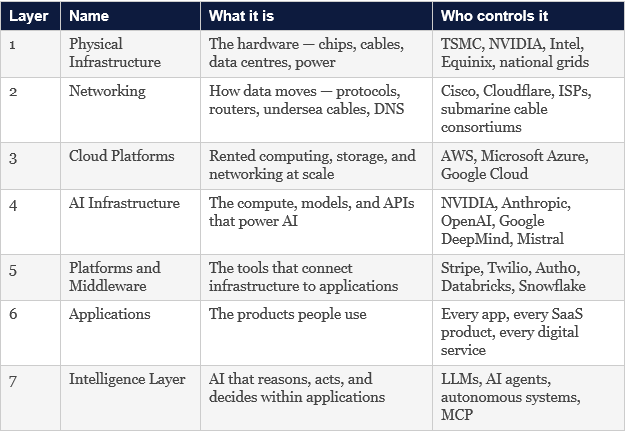
Each layer is its own industry. Each one has dominant players, critical chokepoints, and strategic dynamics that shape what is possible for everyone building above it.
Let us go through each one.
LAYER 1: PHYSICAL INFRASTRUCTURE
The hardware that makes everything else possible
What it is
Everything digital is, at its foundation, physical. Chips. Servers. Cables. Data centres. Power grids. Cooling systems. The idea that the internet or AI exists in some abstract cloud is a comfortable fiction. It exists in buildings, on land, drawing electricity, generating heat, requiring water for cooling.
The physical layer is where the most significant strategic battles of the current era are being fought, because whoever controls the physical substrate controls everything built on top of it.
The chips
Semiconductors are the foundation of the entire digital economy. Every computation, every AI inference, every transaction, every database query runs on a chip. The chip industry has a level of geographic concentration that should concern every government and every technology leader.
TSMC (Taiwan Semiconductor Manufacturing Company). Manufactures approximately 90% of the world’s most advanced chips. If you are running a sophisticated AI model, the processor it runs on was almost certainly made by TSMC. The company is located in Taiwan, a geopolitical flashpoint that has made chip supply chains a matter of national security policy for the United States, China, and Europe simultaneously.
NVIDIA. Designs the GPUs that have become the essential compute substrate for training and running large AI models. NVIDIA’s H100 and A100 chips are so critical to AI development that access to them has become a geopolitical lever. The US government’s export controls on advanced chips to China are essentially export controls on NVIDIA’s most capable products.
AMD and Intel. Significant players in CPUs and increasingly in GPUs. Intel’s foundry ambitions are a bet on reshoring chip manufacturing to the US. AMD’s GPU products compete with NVIDIA in the AI training market.
ASML. The Dutch company that makes the extreme ultraviolet lithography machines that TSMC and other chip manufacturers use to etch the most advanced chips. ASML makes the machines that make the chips that run AI. There is effectively no substitute for ASML at the leading edge. One company in one country controls a critical chokepoint in the global technology stack.
Data centres
AI requires enormous amounts of compute, and compute requires physical space, power, and cooling. The data centre industry is experiencing its most significant expansion in history driven by AI demand.
Equinix. The world’s largest data centre company, operating over 240 data centres across 70 cities. The connective tissue of the internet, connecting thousands of networks in physical locations called internet exchange points.
Hyperscale data centres. Amazon, Microsoft, and Google each operate their own massive data centre estates to power their cloud businesses. These facilities consume gigawatts of electricity. Microsoft’s partnership with a nuclear power company to restart Three Mile Island is a direct response to the power demands of AI infrastructure.
Why this layer matters
Every AI model, every application, every piece of software runs on physical hardware manufactured by a small number of companies in a small number of countries. The physical layer is where national security, industrial policy, and technology strategy intersect. It is also the layer where the compounding effects of investment last longest — a chip manufacturing plant takes five to ten years and $20 billion to build.
LAYER 2: NETWORKING
How data moves across the world
What it is
The networking layer is how data moves from one place to another. From your device to a server. From a server in Dublin to a server in Singapore. From an AI data centre to an application. Without the networking layer, the physical hardware is islands.
The protocols
Protocols are the agreed-upon rules for how data is packaged, addressed, transmitted, and received. We covered the most important of these in the first article of this series. HTTP is the protocol for web communication. TCP/IP is the protocol suite for how data is routed across the internet. TLS is the protocol for encryption.
These protocols were designed in the 1970s, 80s, and 90s by small groups of engineers who made decisions that shape the internet you use today. The fact that the web is open, that any website can link to any other website, that any device can communicate with any server, is not inevitable. It is the result of specific design choices made by specific people at specific moments.
The physical network
Undersea cables. 97% of international internet traffic travels through undersea fibre optic cables. There are approximately 500 of these cables crisscrossing the ocean floor, totalling over 1.3 million kilometres in length. They are physically vulnerable and strategically critical. When the Tonga undersea cable was severed in 2022 following a volcanic eruption, the island nation was almost entirely cut off from the internet for five weeks.
Internet Exchange Points. Physical locations where different networks connect to exchange traffic. The most important ones are in Frankfurt, Amsterdam, London, and Ashburn, Virginia. The speed and cost of internet traffic between regions is significantly determined by the infrastructure at these exchange points.
The companies
Cloudflare. Sits between the internet and millions of websites, providing DDoS protection, content delivery, DNS, and increasingly, AI inference at the edge. Cloudflare sees a significant fraction of the world’s internet traffic and makes decisions about what reaches its destination and what does not.
Akamai. One of the oldest and largest content delivery networks. Caches content at locations close to end users so that the Netflix video or the news article you request does not have to travel all the way from a central server.
Internet Service Providers. The companies that provide your internet connection. AT&T, Comcast, BT, MTN, Safaricom. The final mile from the internet to your device is controlled by a relatively small number of companies in each geography, and the quality and cost of that connection varies dramatically around the world.
Why this layer matters
The networking layer determines who can communicate with whom, at what speed, and at what cost. Net neutrality debates, internet shutdowns by governments, and the geographic disparities in connectivity are all consequences of how this layer is structured and who controls it. In an AI-dependent world, latency in the networking layer directly determines the quality of AI-powered experiences.
LAYER 3: CLOUD PLATFORMS
Computing as a utility
What it is
The cloud is not a place. It is someone else’s computer, rented by the hour. The cloud computing model transformed the economics of software from a capital expenditure, you had to buy and maintain your own servers, into an operational one, you rent exactly the compute you need for exactly as long as you need it.
This shift enabled startups to launch global products without building data centres. It enabled enterprises to scale without predicting future demand. It enabled researchers to train AI models that would have been physically impossible to run on privately owned hardware.
The three dominant providers
Amazon Web Services (AWS). The pioneer and still the largest cloud platform. Launched in 2006, AWS now generates more profit than Amazon’s entire retail business. It offers over 200 distinct services covering compute, storage, databases, networking, AI, machine learning, security, IoT, and more. Its breadth and maturity make it the default choice for most organisations starting their cloud journey.
Microsoft Azure. The second-largest cloud platform and the fastest growing. Azure’s dominance in enterprise software, combined with its deep partnership with OpenAI, has made it the leading platform for enterprise AI workloads. The integration of Microsoft 365, Azure Active Directory, and Azure OpenAI Service creates a bundled proposition that is difficult for enterprise buyers to resist.
Google Cloud Platform. The third major platform. Google’s data and AI capabilities, particularly through Vertex AI and the Gemini model family, give it differentiated strength in AI and analytics workloads. Google Cloud also benefits from Google’s own infrastructure, which is in many respects the most sophisticated network in the world.
What cloud platforms provide
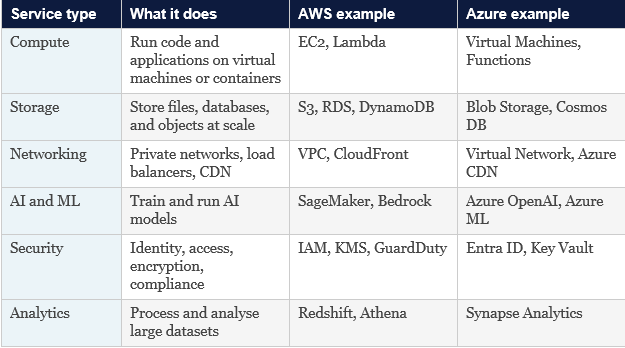
Why this layer matters
The cloud layer is where most AI capability is delivered and where most digital products are built. The three dominant providers control the infrastructure for a significant fraction of the global economy. When AWS has an outage, thousands of websites and applications go down simultaneously. The concentration of critical infrastructure in three companies is both an efficiency and a systemic risk.
LAYER 4: AI INFRASTRUCTURE
The compute, models, and APIs powering the intelligence era
What it is
The AI infrastructure layer sits on top of cloud platforms and physical hardware but is distinct enough to warrant its own category. It encompasses the companies that build, train, and serve AI models, the specialist hardware required to run them, and the APIs and platforms through which AI capability is accessed.
This is the layer that has seen the most dramatic change in the last three years and the one with the most significant implications for every layer above it.
The frontier model providers
Anthropic. The company that builds Claude. Founded in 2021 by former OpenAI researchers, Anthropic focuses on AI safety and interpretability alongside capability. Claude is widely considered one of the strongest models for long-context reasoning, nuanced writing, and following complex instructions. Anthropic also created MCP, the Model Context Protocol, which we covered in Part 5 of this series.
OpenAI. The company that launched the current era of public AI with GPT-3 in 2020 and ChatGPT in 2022. OpenAI’s model family, including GPT-4o and the o-series reasoning models, and Codex for software engineering, are among the most widely deployed AI systems in the world. Microsoft’s $13 billion investment has made Azure the primary delivery platform for OpenAI’s models.
Google DeepMind. The combined research organisation formed from Google Brain and DeepMind. Responsible for the Gemini model family, AlphaFold (which solved the protein folding problem), and an enormous volume of fundamental AI research. Google has unique advantages in data, infrastructure, and distribution that make it a formidable long-term competitor.
Meta AI. Meta’s open-source AI research and deployment arm. The Llama model family has been released with open weights, meaning any developer can download and run these models without paying API fees. This open approach has seeded an enormous ecosystem of derivative models, fine-tunes, and applications and represents a fundamentally different philosophy about how AI development should work.
Mistral. The French AI company that has become Europe’s most significant frontier model provider. Mistral’s models are available in both open and commercial versions and have found strong adoption among developers who want capable, efficient models with more favourable data handling practices for European regulatory environments.
xAI. Elon Musk’s AI company, producing the Grok model family. Available via X (formerly Twitter) and as a standalone API. Less widely deployed in enterprise than the other providers but growing rapidly.
The AI compute layer
NVIDIA CUDA ecosystem. CUDA is NVIDIA’s programming framework for GPU computing. Because AI researchers and developers have been using CUDA for over a decade, an enormous ecosystem of software, frameworks, and tools is built on it. Switching away from NVIDIA hardware is not just a matter of replacing chips. It requires re-engineering the software stack. This lock-in is NVIDIA’s deepest competitive moat.
TPUs (Google Tensor Processing Units). Google’s custom silicon designed specifically for AI workloads. Google uses TPUs internally to train Gemini and other models and offers them via Google Cloud. They are particularly efficient for specific AI tasks but require more engineering effort to use than NVIDIA’s ecosystem.
Challenger chip companies. AMD is the most credible competitor to NVIDIA in AI chips. Startups including Cerebras, Groq, and Tenstorrent are building architectures specifically optimised for AI inference. The race to challenge NVIDIA’s dominance in AI compute is one of the most significant technology competitions currently underway.
AI APIs and platforms
Most organisations access AI capability not by training their own models but by calling APIs that give them access to someone else’s trained model. The economics are compelling: a frontier model costs hundreds of millions of dollars to train. Using an API, you pay only for what you use.
Anthropic API. Access to Claude models via a standard REST API. Used by developers, enterprises, and platforms to embed Claude’s reasoning capability in their own products.
OpenAI API. Access to GPT-4, GPT-4o, o1, o3, and Codex. The most widely used AI API in the world. The plugin and tool-use frameworks pioneered by OpenAI helped establish patterns that the entire industry now follows.
Hugging Face. The open-source AI platform that hosts thousands of models, datasets, and demos. If a model has been trained and released publicly, it is almost certainly available on Hugging Face. The platform has become the de facto repository and community for open AI development.
AWS Bedrock and Azure AI Foundry. Cloud-native platforms that let developers access multiple AI models from multiple providers through a single interface. Reduces the integration complexity of working with multiple model providers.
Why this layer matters
The AI infrastructure layer is where the most significant wealth creation and competitive differentiation is occurring right now. The companies that control frontier model capability, specialised compute, and the developer ecosystems around them are shaping what is possible for every application built above them. Access to this layer, or lack thereof, is already a source of competitive advantage across every industry.
LAYER 5: PLATFORMS AND MIDDLEWARE
The connective tissue of the digital economy
What it is
The platform and middleware layer consists of specialised services that application developers use to add specific capabilities to their products without building those capabilities from scratch. These companies sit between the infrastructure layers below and the applications above, providing the functional components that would otherwise require years of engineering to build independently.
This layer is often underappreciated but represents some of the most durable businesses in the technology industry. The companies in this layer are embedded into thousands of applications, making them extremely difficult to displace.
Key companies and what they do
Stripe. Payment processing infrastructure. When you pay for something online, there is a significant probability that Stripe is processing the transaction invisibly. Stripe handles the complexity of card networks, bank relationships, fraud detection, compliance, and multi-currency payments so that developers can add a payment button with a few lines of code.
Twilio. Communications infrastructure. Phone calls, SMS messages, WhatsApp messages, and email sent by applications you use are frequently routed through Twilio. The verification code you receive when you log into a new service, the appointment reminder from your doctor, the shipping notification from an e-commerce site — Twilio powers an enormous fraction of this.
Auth0 and Okta. Identity and authentication infrastructure. The login systems for thousands of applications are built on Auth0. When you log in with Google or sign up with an email and password on a modern application, the identity verification is often managed by a service like Auth0 rather than by the application itself.
Snowflake. Cloud data warehousing. The platform on which organisations store, query, and share large volumes of structured data. An enormous fraction of enterprise data analysis runs on Snowflake.
Databricks. Data and AI platform. Where Snowflake excels at structured analytics, Databricks handles the combination of data engineering, machine learning, and AI at scale. Used by data teams at large organisations to prepare the data that feeds AI models.
Salesforce. Customer relationship management and enterprise software platform. Salesforce is both a product and a platform — an ecosystem of applications built on its infrastructure that manages customer data and business processes for hundreds of thousands of companies.
Vercel and Netlify. Frontend deployment platforms. Where developers deploy web applications. Abstract away the complexity of servers, CDNs, and deployment pipelines. The website you visit that loads quickly on every continent is probably deployed on a platform like Vercel.
Why this layer matters
The middleware layer represents decades of accumulated engineering that no single company could replicate efficiently. Its importance to understanding the stack is that it reveals how specialisation works in technology. The most efficient digital economy is not one where every company builds everything. It is one where specialised platforms handle universal functions, freeing application developers to focus entirely on the specific value they create for their users.
LAYER 6: APPLICATIONS
Where humans meet the stack
What it is
The application layer is where people live. The banking app, the messaging platform, the productivity suite, the e-commerce store, the social network. These are the products and services that billions of people interact with daily, often without any awareness of the six layers they sit on top of.
Applications are the most visible part of the stack but often the most commoditisable. The competitive advantage of most applications does not come from the infrastructure they use, which is largely shared with competitors, but from the data they accumulate, the network effects they create, and the user experience they deliver.
Categories of applications
Consumer applications. Social networks, messaging apps, entertainment platforms, e-commerce. The applications used by billions of people daily. WhatsApp, Instagram, TikTok, Netflix, Amazon. These applications generate enormous amounts of data, which feeds back into their AI capabilities, which improves the product, which generates more data.
Enterprise software. The applications used by businesses to manage their operations. Microsoft 365, Google Workspace, Slack, Notion, Jira, SAP, Workday. These products have historically had long replacement cycles and deep switching costs, creating durable competitive positions for incumbents.
Vertical SaaS. Software built for specific industries. Healthcare records management, legal practice management, construction project software, agricultural supply chain tools. These applications often run on the same infrastructure as general-purpose SaaS but contain domain-specific logic that makes them difficult to replace.
Developer tools. The applications used by engineers to build applications. GitHub, VS Code, Postman, Datadog, PagerDuty. This category is being transformed by AI more rapidly than almost any other, with AI coding assistants like GitHub Copilot and Claude Code changing how software is written.
Why this layer matters
The application layer is where most professionals interact with the stack and where most of the visible value of the digital economy is captured by users. But the most strategically important decisions about applications are made at lower layers. The cloud platform you build on determines your cost structure. The AI model you integrate determines your capability. The payments infrastructure you use determines what markets you can serve. Understanding the layers below determines the strategic decisions you make at the application layer.
LAYER 7: THE INTELLIGENCE LAYER
AI that reasons, acts, and decides
What it is
The intelligence layer is the newest addition to the stack and the one changing every other layer most rapidly. It consists of the AI systems that sit within and between applications, making decisions, generating content, taking actions, and coordinating across tools and data sources.
We covered the components of this layer in detail earlier in this series: Large Language Models, AI agents, RAG systems, and MCP. In the context of the full stack, the intelligence layer is what converts the compute at Layer 1 and the data at Layer 5 into decisions and actions that create value for users at Layer 6.
The components
Large Language Models. The reasoning engines. LLMs from Anthropic, OpenAI, Google, and others process natural language, code, images, and structured data to produce outputs that range from a customer service response to a software pull request to a financial analysis.
AI Agents. LLMs that act, not just respond. Agents use tools, call APIs, make decisions across multiple steps, and complete tasks autonomously. We are in the early stages of agent deployment but the trajectory is clear: AI agents will handle an increasing fraction of the work that currently requires human attention for each step.
RAG Systems. Retrieval Augmented Generation. The architecture that connects AI models to specific data sources, giving them access to knowledge that was not in their training data. RAG is what makes an AI system useful for your specific business rather than just for general questions.
MCP — Model Context Protocol. The emerging standard for how AI models communicate with tools and systems. MCP is to AI agents what HTTP was to the web: a common protocol that allows any compliant AI to connect to any compliant tool. We dedicated a full article to this in the series.
AI Orchestration Platforms. Systems like LangChain, LlamaIndex, and Microsoft AutoGen that coordinate multiple AI models and tools to complete complex multi-step workflows. As AI agents become more capable and more numerous, the orchestration layer that coordinates them becomes increasingly important.
Why this layer matters
The intelligence layer is where the stack becomes autonomous. Every previous layer is infrastructure that humans use. This layer is infrastructure that acts on humans’ behalf. The implications for every profession, every industry, and every organisation are enormous. The professionals and leaders who understand how this layer works are the ones best positioned to direct it rather than be displaced by it.
Why the Layers Are Inseparable
Understanding each layer individually is useful. Understanding how they depend on each other is essential.
Consider a single AI-powered interaction: a customer asks a retail bank’s AI assistant why their payment was declined.
Layer 7: An AI agent receives the question and plans how to answer it. It decides it needs to check the transaction record and the customer’s balance.
Layer 6: The banking application passes the question to the AI layer and receives a response it displays to the customer.
Layer 5: The AI agent calls the bank’s internal API via an MCP server. Stripe processes any related transaction data. Auth0 verifies the customer’s session is valid.
Layer 4: The AI agent’s response is generated by a language model running on cloud AI infrastructure via an API call to Anthropic or OpenAI.
Layer 3: The API call, the database query, and the response all travel through AWS or Azure cloud infrastructure.
Layer 2: The data moves across networking infrastructure from the bank’s servers to the cloud platform to the AI provider and back.
Layer 1: At the bottom, NVIDIA GPUs in a data centre somewhere process the AI inference while TSMC-manufactured chips handle the computation everywhere else in the chain.
That sequence happens in under two seconds. Every layer is essential. Remove one and the interaction fails.
The stack is not a set of optional layers. It is a dependency chain. The reliability and capability of every layer you depend on propagates upward into every product you build. This is why the companies that control lower layers have disproportionate strategic leverage over everyone building above them.
Who Controls What — and Why It Matters
The most important strategic insight from understanding the stack is understanding where power is concentrated.
The concentration paradox
The internet was designed to be decentralised. Its original architecture was specifically intended to route around failure and censorship. And yet the practical reality of the modern internet is one of extraordinary concentration.
Three companies, AWS, Azure, and Google Cloud, provide the cloud infrastructure for the majority of the world’s digital economy.
One company, TSMC, manufactures the most advanced chips for almost every major technology company.
One company, ASML, makes the machines that TSMC uses to make those chips.
A small number of frontier AI models from three or four companies provide the intelligence capability embedded in thousands of applications.
A small number of undersea cable routes carry the majority of intercontinental internet traffic.
This concentration creates efficiency. It also creates risk. A failure, attack, or policy decision at any of these chokepoints has cascading effects across the entire stack and across every industry that depends on it.
The geopolitical dimension
Technology infrastructure has become a geopolitical asset. The US export controls on advanced AI chips to China are an attempt to slow the development of the Chinese AI stack by restricting access to NVIDIA’s products. China’s investment in domestic semiconductor manufacturing is a response to that vulnerability. Europe’s AI Act and data sovereignty regulations are an attempt to impose European values on a stack largely controlled by American companies.
These are not abstract policy debates. They determine which AI models can be used in which countries, which chips can be exported, which data can be stored where, and which companies can build on which infrastructure. For any professional or organisation building on this stack, these dynamics are directly relevant to strategic planning.
The open source counter-force
Against this concentration sits an equally significant counter-force: open source. Meta’s release of the Llama model weights. The Linux operating system that powers the servers in nearly every data centre. The open protocols, HTTP, TCP/IP, TLS, that make the internet interoperable. The open-source software frameworks, PyTorch, TensorFlow, React, Node.js, that millions of developers build on.
Open source distributes control. It means that even if a dominant commercial provider disappears or raises prices dramatically, an open alternative often exists. The tension between proprietary and open-source technology is one of the defining dynamics of the current era, and it plays out at every layer of the stack.
What This Means for You
Understanding the stack is not an academic exercise. It changes how you make decisions, build products, and position yourself professionally.
For product managers and founders
Every product decision you make is constrained by and enabled by the layers below you. The cloud platform you choose determines your cost structure, your geographic availability, and your access to AI services. The AI model you integrate determines the quality of your intelligence layer. The middleware services you use determine what you can ship quickly versus what you need to build.
Understanding the stack means you can evaluate these constraints clearly. You know when a technical decision is actually a strategic one. You know which layers you can afford to abstract over and which ones you need to understand deeply.
For engineers and architects
The stack gives you a map for diagnosing problems and identifying opportunities. When a system fails, you can trace the failure through the layers and identify where the root cause sits. When you are designing a new system, you can see which layers give you leverage and which ones give you risk.
The intelligence layer in particular is changing the engineering profession. The engineers who understand how AI infrastructure works, how to prompt and direct AI models effectively, and how to build agentic systems are the ones with the most leverage in the current market.
For business leaders and strategists
The stack reveals the concentration of power that shapes every market. Understanding which companies control which chokepoints tells you where the strategic risks sit in your supply chain. Understanding which layers are commoditising tells you where your own margin is under pressure. Understanding which layers are consolidating tells you where the next platform shift might come from.
The organisations that navigate the next decade most effectively will be the ones whose leaders understand the infrastructure that their business runs on and the strategic implications of that infrastructure’s structure.
The stack is not just an engineering concern. It is a business strategy concern. The company that controls a layer below you has leverage over you. The layer you understand most deeply is the layer you can use most effectively. Every professional who builds, leads, or invests in technology companies should have a working mental model of the full stack.
Reflection for the Week
We started this series with something simple: the internet is just two things talking to each other.
Every article since then has added a layer. HTTP and APIs. LLMs and agents. RAG and vector databases. MCP and integration standards. The tools built on top. The fundamentals that make them work.
This article has been about zooming out far enough to see the entire picture at once. The chips at the bottom. The cloud in the middle. The intelligence at the top. The platforms connecting them. The applications where people live. And the invisible protocols and companies whose decisions shape every interaction.
The stack is not static. Every layer is changing. AI is accelerating the change in every layer simultaneously. The intelligence layer is reshaping applications. Applications are reshaping the demand for middleware. Middleware is reshaping cloud architectures. Cloud demand is reshaping physical infrastructure. And physical infrastructure needs are reshaping geopolitics.
Understanding where you sit in that stack, what you depend on, what controls you, and what you can shape, is one of the most strategic things any professional can do right now.
The question worth sitting with this week:
In the stack that runs your daily work, which layer do you understand least well? And what would change about how you make decisions if you understood it properly?
Want to go deeper on any layer?
Each layer in this article has its own dedicated deep-dive in the Web 4.0 Basics series at Learn with Tochii. From how HTTP works to how to build an MCP server to how to use Claude Code in production.
The 14-week Amakora AI Product and Systems Fellowship teaches the full stack across live weekly classes, starting next month.
Read the series: tochiiachebe.substack.com Apply: amakoragroup.com/apply
Until next week,
Tochii
Founder, Learn with Tochii | Amakora Group
Inspire · Educate · Empower